Passage 1
The brain is truly a marvel. A seemingly endless library, whose shelves house our most precious memories as well as our lifetime's knowledge. But is there a point where it reaches capacity? In other words, can the brain be “full” ? The answer is a resounding no, because, well, brains are more sophisticated than that. A study published in Nature Neuroscience earlier this year shows that instead of just crowding in, old information is sometimes pushed out of the brain for new memories to form. Previous behavioral studies have shown that learning new information can lead to forgetting.But in this study, researchers used new neuroimaging techniques to demonstrate for the first time how this effect occurs in the brain. The paper's authors set out to investigate what happens in the brain when we try to remember information that's very similar to what we already know. This is important because similar information is more likely to interfere with existing knowledge, and it's the stuff that crowds without being useful.
To do this, they examined how brain activity changes when we try to remember a “target”memory, that is, when we try to recall something very specific, at the same time as trying to remember something similar (a “competing” memory). Participants were taught to associate a single word (say, the word sand) with two different images--such as one of Marilyn Monroe and the other of a hat. They found that as the target memory was recalled more often, brain activity for it increased.Meanwhile, brain activity for the competing memory simultaneously weakened. This change was most prominent in regions near the front of the brain, such as the prefrontal cortex, rather than key memory structures in the middle of the brain, such as the hippocampus, which is traditionally associated with memory loss. The prefrontal cortex is involved in a range of complex cognitive processes, such as planning,decision making, and selective retrieval of memory. Extens
- A.It can forget what we want to remember
- B.It can memorize what we want to remember
- C.It can store limitless information like a library
- D.It forgets the old information while absorbing the new
正确答案及解析
正确答案
解析
细节题。由第二段中的“…instead ofjust crowding in,old information is sometimespushed out of the brain for new memories to form”可知,大脑不会储存满是因为大脑在形成新的记忆的时候旧的信息会被清除,因此 D 项符合题意。A 项“大脑能够忘掉我们想记住的东西”,B 项“大脑能够记住我们想记住的东 西”,C 项“大脑能够像图书馆一样储存无限的信息”,说法均不准确。
包含此试题的试卷
你可能感兴趣的试题
《义务教育数学课程标准(2011年版)》强调,课程内容要反映社会的需要、数学的特点,要符合学生的认知规律。课程内容的组织要重视过程,处理好()的关系。
-
- A.预设与生成
- B.抽象与具体
- C.数学与实际生活
- D.过程与结果
- 查看答案
设α是某一方程组的解向量,k为某一常数,则kα也为该方程组的解向量。( )
- 查看答案

-
- A.0
- B.1
- C.2
- D.3
- 查看答案
案例:
在有理数运算的课堂教学片段中,某学生的板演如下:
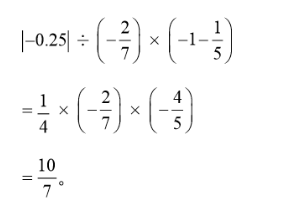
针对该学生的解答,教师进行了如下教学:
师:请仔细检查你的演算过程,看是否正确无误?
生:好像正确吧。
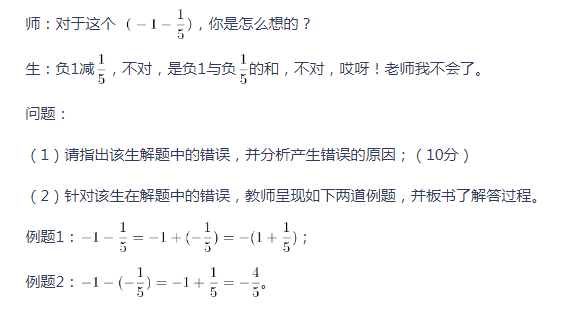
请分析例题1、例题2中每一步运算的依据。(10分)
- 查看答案
初中数学课程是一门国家课程,其主要内容包括课程目标、教学内容、教学过程和( )等
-
- A.评价手段
- B.教学方法
- C.教学手段
- D.教学实践
- 查看答案