请以下列材料为依据,用英文进行一个课时的教学设计,包括教学目标和教学过程,设计意图可使用中文。
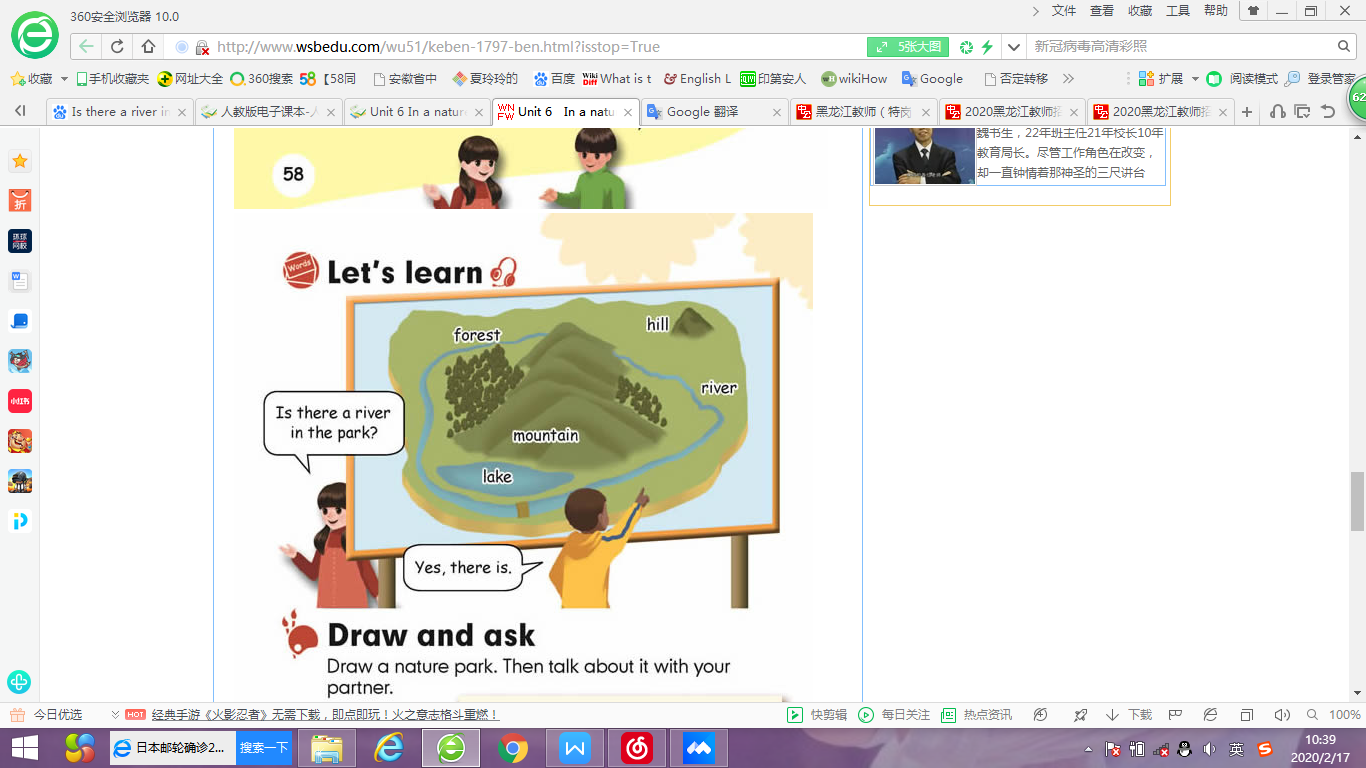
教学材料:
正确答案及解析
正确答案
解析
1. Teaching objectives:
(1)Knowledge objectives:
Students can master some new words about nature, such as mountain, lake, river, forest and hill, and understand the sentence pattern: Is there a ... in the park? Yes, there is.
(2)Ability objectives:
Students’ ability of listening and speaking will be improved, and they can know some nature things and use them into daily life.
(3)Emotional objectives:
Students can foster the interest and desire of learning English, and their awareness of protecting nature will be improved.
2. Teaching procedures
Step 1 Warm-up&Lead-in
Before class, greet to the students. After that, show some pictures of nature, such as forest, hill, and park. And then ask them to discuss what they are.
(设计意图):通过学生自由讨论的方法,能够自然地导入今日的课程,并且激发他们的已有知识。
Step 2 Presentation
①Show some pictures, and draw some stick figures to teach the new words, such as: hill, forest, mountain, and lake.
②Help students with pronunciation and spelling of the new words or phrases.
③Students listen to the tape and answer some questions to introduce the key sentence pattern. Teacher asks and students answer by using the new words and sentences.
1. Is a river in the park? Yes,_____________.
2. Is there a forest in the park?Yes,__________________.
3. Is there a _____in the river?Yes,there is.
④Students listen to the tape again, read and imitate after the recording correctly and emotionally.
(设计意图):通过呈现图片和画简笔画的方式教授一些重要的单词,易于学生理解。学生通过两遍的听听力,自然引入新课的句型,使学生对听力内容有了全面的了解,并且使学生的听力能力有了进一步的提高。
Step 3 Practice
① Students make a new dialogue according to the new words.
② Play a game called Hot Potato: teacher turns around and plays the music or claps his/her hands as he/she passes a pen to a student, and the student need pass it to the others. When the music stops, the student who holds a “potato” should answer a question by using the new phrases and sentences.
(设计意图):学生通过游戏以及竞争的形式在轻松愉快的环境下操练所学内容,不仅激发了学生的学习动力,还能够很好地复习单词和句型。
Step 4 Production
Divide students into several groups and let them work with their classmates to draw their favourite nature parks. After that, have a discussion about :Is there a ___in the park? Yes, there is.
(设计意图):通过分组的方式,让学生画出他们最喜爱的自然公园,再用今日所学知识展开讨论,这不仅可以帮助学生复习到所学的内容,激发了学生的兴趣,而且培养了学生的综合语言运用能力。
Step 5 Summary and Homework
Invite a student as an assistant to summarize what we have learned today. And then give them a homework: make a poster about the nature.
(设计意图):学生自主总结所学内容并运用所学自己设计关于自然的海报,这样有利于巩固学生内容,提高学生的综合素质。
你可能感兴趣的试题
“有为才有位,有位更有为”,这一看法给我们的启示是( )
-
- A.实践决定认识,认识对发展具有推动作用
- B.实现人生价值必须先要实现人的自我价值
- C.人生真正价值在于社会价值与自我价值的统一
- D.要发挥主观能动性,要不断积累自我价值
- 查看答案
历史唯物主义认为人的价值在于( )
-
- A.个人的自我创造和自我实现
- B.个人的自我选择和自由发展
- C.个人主体性的增强和摆脱社会的制约
- D.个人对社会的贡献和社会对个人的尊重
- 查看答案
对立统一规律揭示了事物发展的( )。
-
- A.辩证形式
- B.趋势和道路
- C.不同状态
- D.源泉和动力
- 查看答案
矛盾的普遍性与特殊性的关系是( )
-
- A.一般与个别的关系
- B.整体与局部的关系
- C.绝对与相对的关系
- D.可以相互转化的关系
- 查看答案
在认识过程中具有更为重要意义的飞跃是指()
-
- A.从外在形象到内在本质的飞跃
- B.从个性认识到共性认识的飞跃
- C.从肯定阶段到否定阶段的飞跃
- D.从理性认识到实践的飞跃
- 查看答案